Case 01 / Floodlight, Inc. · 2025 — present
Austin, Texas
Climate risk, priced for a portfolio.
The engine behind more than three hundred client reports: annual loss, 95 and 99 percent Value-at-Risk and maximum loss per asset, with the loss attributed to individual hazards and recommendations written by a model.
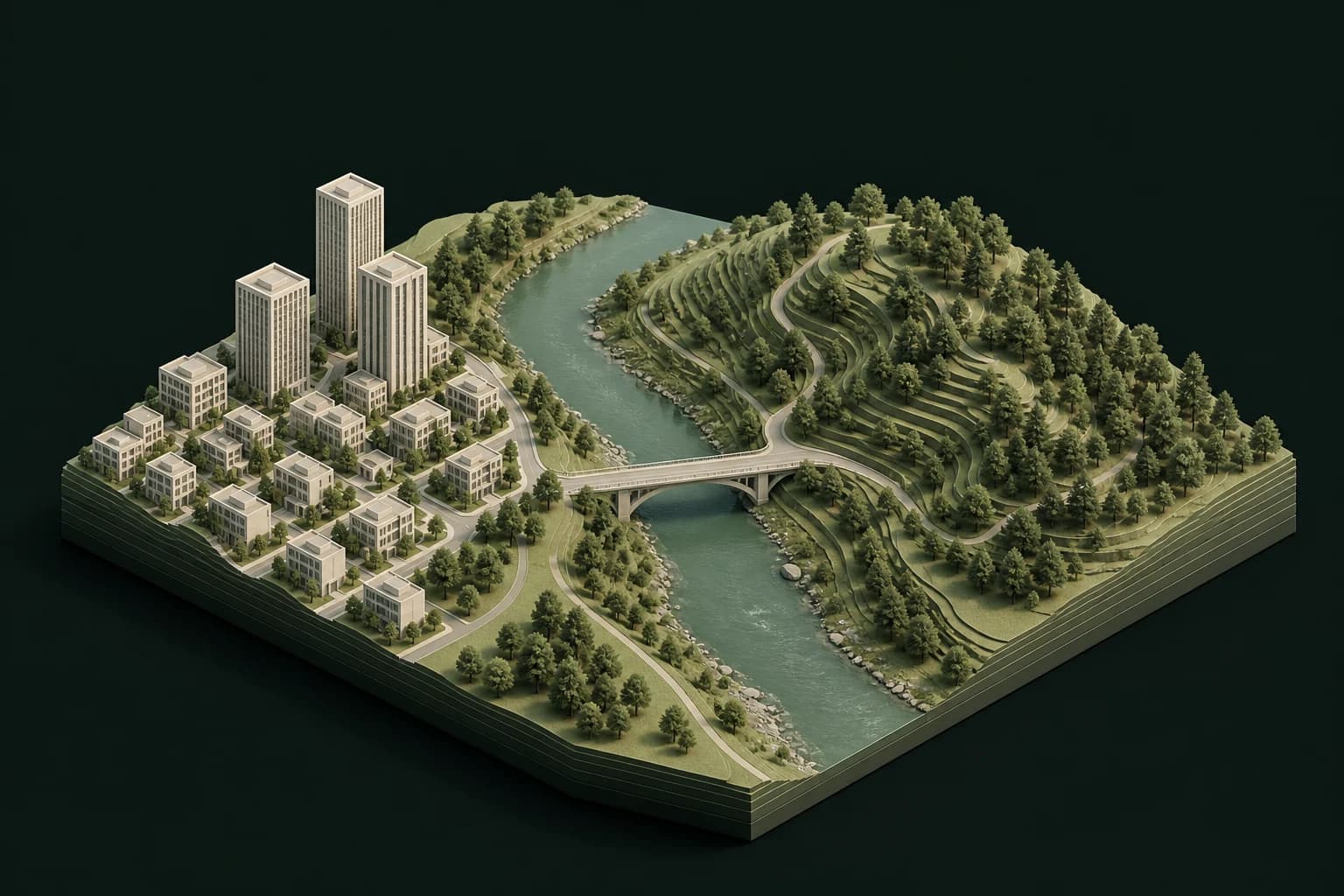
Follow the water.
Low-lying assets meet rising water. Location turns a hazard into exposure.
300+client reports
Problem
Floodlight turns physical climate risk into financial information for real assets. The work connects annual loss and tail-risk estimates with individual hazards, recommendations, and client reports. Report generation took roughly two minutes before the caching and query improvements.
Role
I joined as an intern on the data side and took ownership of the engine when I moved to AI Engineer I in May 2026. I own the model, the report pipeline that sits on it, and the technical audit that decides what changes next.
Approach
The core outputs are annual loss, Value-at-Risk at the 95th and 99th percentile, and maximum loss, each attributed back to the hazard that caused it. I added a report-caching layer and reworked the PostgreSQL queries underneath, which took generation from roughly 120 seconds to under ten. On top of that I shipped LLM-generated recommendations and per-hazard attribution across the dashboard and the CVaR reports, and designed the scenario-planner architecture indexed by global warming level, so a warmer world is a control rather than a rerun.
Engineering focus
The work spans model outputs, database performance, and production operations. Alongside the CVaR work, I resolved an outage caused by runaway logs filling a disk and taking MySQL down, and averted a destructive database restore.
Outcome
The engine runs in production behind every client report, and the wait between asking for one and reading it is now short enough that an analyst can open it while the client is still on the call. Each loss figure names the hazard behind it and arrives with a written recommendation, so the report explains itself. The scenario planner turns a warmer world into a control the team can set rather than a run someone has to schedule.
What this demonstrates
I can carry one system from the model through the queries underneath it to the product surfaces it feeds, and stay on it when production breaks. I am co-authoring a Climate VaR paper on the same work.
Next case / Floodlight, Inc.
An atmospheric model an agent can call.